
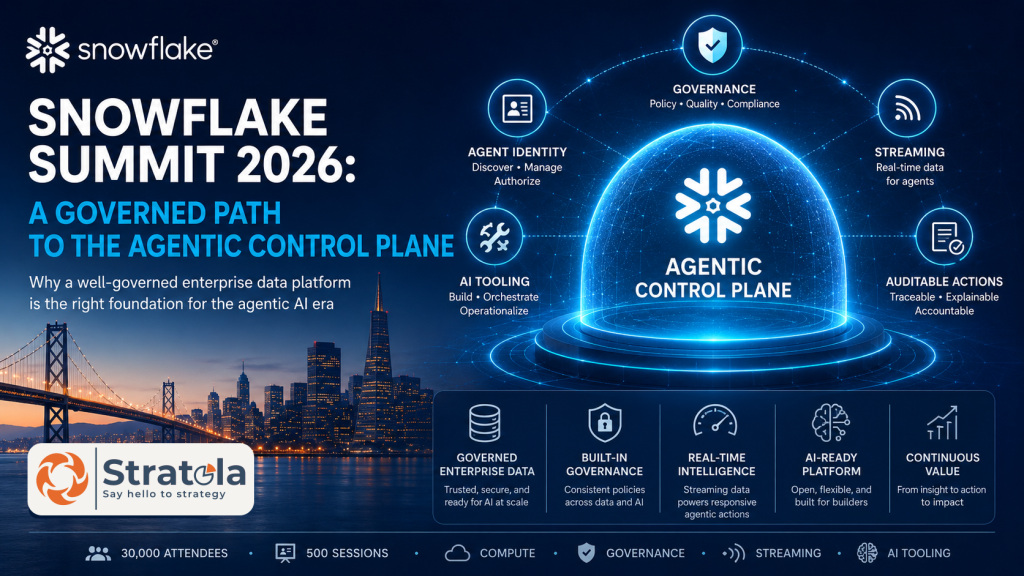
Snowflake used its 2026 Summit in San Francisco to make its most explicit and comprehensive argument yet for why a well-governed enterprise data platform is the right foundation for the agentic AI era. With 30,000 attendees, 500 sessions, and a two-day announcement cycle spanning compute, governance, streaming, and AI tooling, Snowflake positioned itself as the agentic control plane for enterprise data.
Having attended both keynote days, the C-suite media and analyst sessions with CEO Sridhar Ramaswamy and his leadership team, and several product breakouts, my read is that the strategic architecture Snowflake has assembled is solid, and the governance investments in particular are real and timely. At the same time, the summit surfaced important gaps between the vision Snowflake is articulating and the product maturity required to deliver it today. The next six to eight months of execution will matter a great deal in demonstrating that Snowflake can deliver generally available products on its roadmap that actually meet industry needs.
Governed Data as the Key to Agentic Control Plane
The general tone and theme at the summit was that as AI agents proliferate across the enterprise, the trusted, governed data platform becomes more valuable, not less. The AI model itself is not a competitive advantage, Ramaswamy argued, because your competitors have access to the same models. The differentiation lies in combining those models with what is uniquely yours, which are your enterprise data, your governance context, and your business definitions. Organizations that invested early in clean, governed data foundations are finding it meaningfully easier to deploy production AI than those operating fragmented data estates.
The more ambitious claim Snowflake is advancing goes further than data governance, however. The company is asserting the role of the agentic control plane, which is, in essence, the layer that governs what agents know, what they can access, what actions they can take, and how every interaction is audited. That is a significant expansion of scope from a “data warehouse vendor” but it is credible because Snowflake starts from a position of established data gravity inside large enterprises.
Key Announcements
Snowflake CoWork (previously Snowflake Intelligence) was repositioned as a personal work agent for knowledge workers, connecting to enterprise tools including Slack, Salesforce, Jira, and Google Drive via Model Context Protocol connectors. New capabilities include:
- Personal Work Agent with multi-agent orchestration that routes requests across specialized agents without user intervention
- User Memory, enabling the platform to adapt to individual working patterns over time
- Scheduled Tasks and Automations for recurring analyses delivered through tools users already rely on
- Next-Generation Artifacts providing governed, live data views that can be certified and shared across the organization
- Deep Research capability for multi-step reasoning across structured and unstructured enterprise data
Snowflake CoCo (previously Cortex Code) was formalized as the AI coding and development agent, now with CoCo for Desktop (generally available June 2), Cloud Agents in Snowsight, extensions for VS Code and Microsoft Excel, a plugin for Claude Code, and a Skill Catalog for sharing proven workflows across teams.
Cortex Sense was introduced as a context unification layer for both CoWork and CoCo. Snowflake cited an improvement in agent evaluation accuracy from 24% to 83% when Cortex Sense is combined with the full product stack. Note: Whether 83% is still trustworthy enough or not is the real question, though!
Horizon Context was announced as a new foundational metadata layer that transforms scattered enterprise context into actionable intelligence for AI through a three-stage pipeline of Collect, Enrich, and Activate. BlackRock was cited as an early adopter using it to maintain shared business definitions across AI and analytics workflows.
Agent Identity is now generally available, allowing Snowflake to distinguish agent sessions from human sessions at the platform level, enabling data masking and row-level security scoped specifically to agent interactions.
Intent-Driven Governance enables administrators to express governance intent in natural language and have Horizon automatically classify data, apply policies, and maintain them continuously across agents, dashboards, and applications. If the product delivers what it promises, this could be a great way to enable governance across enterprises.
On the infrastructure side, Apache Iceberg v3 is generally available inside Snowflake, Snowflake Storage for Apache Iceberg Tables is generally available on AWS and Azure, and Snowflake Datastream (a fully managed Kafka-compatible streaming service with sub-second latency) entered private preview. Zero-copy integrations with SAP, Salesforce, Workday, IBM Watson X Data, and AVEVA Connect were also confirmed or expanded. These are all important developments in enabling the ecosystem to work more openly with Snowflake.
The Natoma acquisition (announced May 27, pending close) will bring an enterprise MCP gateway into the platform, extending Snowflake’s governance perimeter from data assets to AI actions and workflows across more than 100 enterprise systems. Given the agentic control plane positioning, this acquisition seems to be a very strategic move to ensure secure and trustworthy agentic interactions.
What Snowflake Got Right
Governance as a genuine product investment
This is where Snowflake deserves the most analytical credit relative to the competitive field. The Horizon Catalog announcements reflect sustained engineering investment rather than positioning layered onto existing features. Agent Identity addresses a concrete and pressing enterprise risk, which is the ability to distinguish agent sessions from human sessions and apply fine-grained access controls accordingly is something most agentic deployments today handle clumsily or not at all. Intent-Driven Governance operates at the right abstraction level for enterprise teams that are stretched thin and cannot manage policy configuration at the column-by-column level.
According to a McKinsey study cited by Snowflake at the Summit, nearly two-thirds of organizations identify security as the top barrier to scaling AI. Snowflake is building directly into that barrier across agent identity, security posture management, data exfiltration controls, and prompt injection safeguards. The breadth and specificity of what was announced suggests this is a sustained product priority rather than a Summit-cycle sprint. Personally, I had a 1:1 product inquiry into the AI governance capabilities today and what is in the roadmap. I have to say that I am really impressed with what I saw. Snowflake is building AI guardrails right into the product rather than punting it to the next tool that might access the data. Kudos to Prasanna Krishnan and her product team!
The Natoma acquisition targets the right problem at the right moment
The MCP ecosystem is maturing faster than most enterprise security teams anticipated. The governance vulnerabilities that come with unmanaged MCP deployments are real and increasingly visible. By acquiring a company with deep expertise in MCP governance, identity management, and privileged access management, Snowflake is making a good bet that governed agentic connectivity will be as commercially important as governed data storage. Early internal results are reportedly promising, even though integration execution will determine how quickly customers see the benefit.
Model and cloud independence as structural architecture
Snowflake’s decision to support Anthropic, OpenAI, Google, Meta, Mistral, DeepSeek, and now SpaceX AI models gives enterprise buyers meaningful flexibility and insulates the platform from dependence on any single provider’s pricing or availability. This mirrors the cloud-independence strategy that became one of Snowflake’s defining competitive advantages and it is the right architecture for a market where model leadership changes rapidly.
Support for the Open Semantic Interchange
One of the quieter but strategically significant moves Snowflake highlighted at Summit was the continued momentum of the Open Semantic Interchange. OSI has achieved 5x growth in its partner ecosystem within six months, with partners now including Databricks, Collibra, Informatica, Qlik, ThoughtSpot, Oracle, and Mistral AI. The initiative, co-founded by Snowflake, Salesforce, and dbt Labs in September 2025, is attempting to solve one of the most persistent and underappreciated problems in enterprise AI, which is fragmented business definitions. When different tools, teams, and agents define “revenue” or “customer” differently, AI outputs are inconsistent and often unreliable. OSI aims to create a vendor-neutral semantic specification that makes business logic portable across platforms. The specification itself went live in January 2026 under Apache 2.0. However, Microsoft, with Power BI dominating enterprise BI adoption, is not a participant. SAP, IBM, and Oracle are absent. And among major AI model providers, only Mistral has joined. OSI has real momentum in the independent data tools ecosystem, but until the largest enterprise software incumbents are at the table, the “universal standard” framing remains aspirational. Snowflake’s bet is that open-source community adoption will create the gravitational pull that eventually will draw the holdouts in. That is a reasonable long game, but enterprise buyers should track participation breadth as the more meaningful indicator than partner count growth alone.
Strong focus on cost governance
This was a recurring theme across the platform and keynote sessions, framed primarily as an enabler for AI adoption. Snowflake extended its existing cost governance and budget tools to cover AI workloads, including Cortex, CoCo, and CoWork, in direct response to customer demand. The new controls include shared warehouse budgets that can be segmented by business unit even across shared compute, per-user quotas for granular spend control, and custom budget actions that trigger automated responses when spending thresholds are reached. Agent-based interactions generate significantly higher query volumes than human-driven queries, and Snowflake’s platform leaders acknowledged that this makes budget guardrails for agents a top priority for customers concerned about runaway cost risk as agentic adoption scales. The new Adaptive Compute billing model also ties into this story, since it bills at the individual query level with costs aggregated for chargeback and showback, giving finance teams more precise accountability as AI-driven query volumes grow.
Where the Snow Got a Bit Slushy
Cortex Sense needs a stronger demo
Across two full days of keynotes and multiple breakout sessions, Cortex Sense never had a moment that demonstrated its actual depth in a way that would satisfy analytical scrutiny. The headline accuracy improvement from 24% to 83% is a striking result that warrants a live demo with a real enterprise use case and transparency into the evaluation methodology. What the Summit delivered instead was a product description and customer testimonials from organizations that had already invested significant effort in building semantic foundations.
The claim of improved accuracy is plausible, but internal benchmarks optimized for a specific architecture can be misleading about real-world performance in enterprise environments without mature semantic models. Snowflake’s own data engineering sessions acknowledged that AI agents are less resilient to mediocre data structures than human analysts. Semantics need to be curated by human experts, and agents that have to infer business logic from raw data produce unreliable outputs. The Cortex Sense accuracy numbers are, therefore, partially a function of how much semantic groundwork has already been done before the capability is deployed. Enterprises arriving without that foundation will need to make that investment first. A more explicit acknowledgment of that prerequisite would serve the market better than leading with the benchmark number alone.
The release state matrix creates real buyer confusion
Across the six or more press releases issued at the Summit, Snowflake deployed at least five distinct availability states simultaneously: Generally Available, Generally Available Soon, Public Preview, Public Preview Soon, and Private Preview. Many of the most compelling announcements, including Cortex Sense, User Memory for CoWork, Cortex Training, and several Horizon Context enrichment capabilities, were either not yet at GA or not yet in public preview. Enterprise buyers making near-term architecture and budget decisions need a much cleaner picture of what is deployable today versus what is on a longer timeline.
Stratola’s Take
Snowflake Summit 2026 was the company’s most strategically solid event under Ramaswamy’s leadership. The positioning of trusted data as being key to the agentic control plane addresses real enterprise dynamics. The governance investments are specific and address security concerns that are top of mind for every enterprise AI program in 2026. The customer examples were also more grounded than typical Summit fare. Samsung’s SIA agent, Under Armor’s data trust framework, Thomson Reuters’ CoCounsel posture, and Sanofi’s Concierge tool represented genuine enterprise implementations with measurable outcomes, not proof-of-concept prototypes.
I loved the strong focus on cost governance, given that we are seeing tokenmaxing anecdotes all around us every day. Not just Snowflake, every data vendor with a strong set of AI tools is going to run into tokenmaxing issues. It cannot be easily dismissed as “not our problem”. Vendors, like Snowflake, must provide data/agentic observability tools for cost, performance, and optimization. Transparency with the users is key to enabling long-term adoption and increased usage.
The Datastream product announcement was a bit of a head-scratcher to begin with. When I asked Snowflake’s product executives about this, they clarified that their intent was not to make this a Kafka-killer. They said that this is for organizations that stood up Apache Kafka primarily as a data collection layer to feed Snowflake, Datastream eliminates the operational overhead of managing a separate streaming infrastructure stack. Topics and tables are treated as the same object, streaming data inherits Snowflake governance and access controls automatically, and existing Kafka client applications can connect without code changes. Kafka is not going away for organizations running high-volume event buses, complex stream processing, or multi-destination fan-out architectures. Those customers have invested heavily in Kafka expertise and ecosystem tooling, and Datastream does not replace that value. Where Datastream makes compelling sense is in a mid-market enterprise that is running Kafka purely because it was the conventional path to Snowflake ingestion, paying for broker management and connector maintenance that adds complexity without adding capability. For that segment, consolidating onto Datastream is a rational simplification. There are several other vendors that are trying to do the same approach, where it eliminates the need for a separate ingestion pipeline.
Snowflake has built a compelling case for why the governed data platform is the right foundation for the agentic enterprise. I am looking forward to seeing the products on the roadmap become generally available soon and get adopted across enterprises. Let us see what an enterprise-ready agentic control plane looks like.