
There is a revealing tension at the heart of SAP’s current strategy. On one hand, SAP is spending billions of dollars acquiring some of the most architecturally sophisticated companies in the enterprise data and AI landscape. On the other hand, it is simultaneously publishing API policies that restrict the very agentic architectures those acquisitions are meant to enable. SAP is a company with a platform identity problem, and its recent acquisition spree, however well-intentioned, is unlikely to resolve it.
The Acquisitions Look Right on Paper
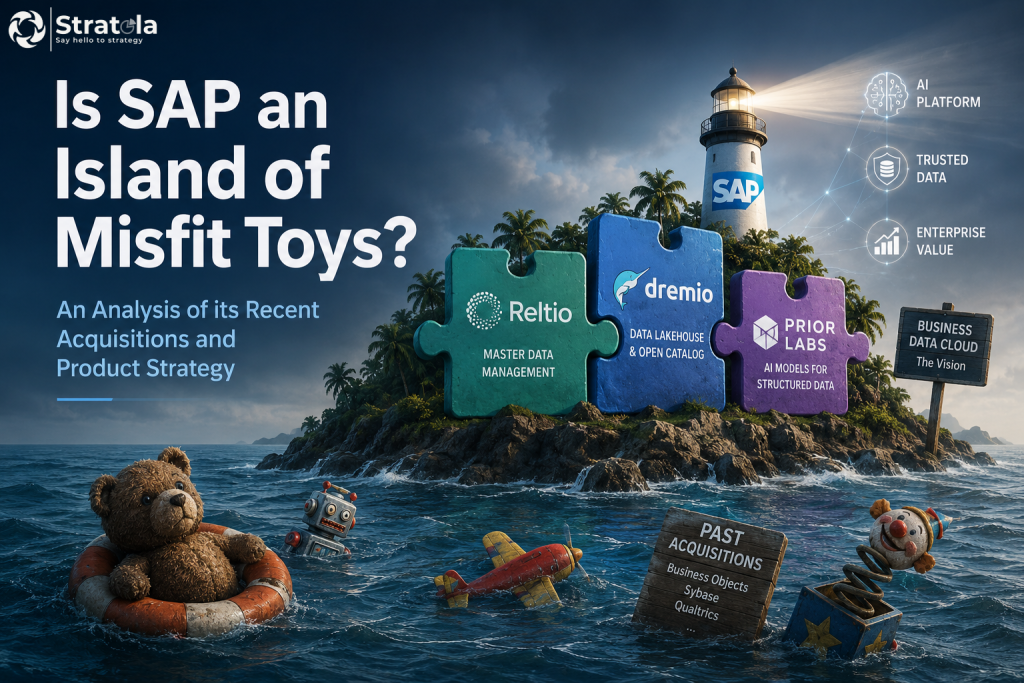
In the span of roughly six weeks in early 2026, SAP announced three acquisitions that, taken together, read like a credible attempt to build a full-stack Data and AI platform. Reltio, acquired in March, brings master data management capabilities designed to unify enterprise data for AI and analytics workloads. Dremio, announced in May and valued at $2 billion from its last funding round, adds an Apache Iceberg-native lakehouse platform built for federated query, agentic access, and open-standard interoperability. Prior Labs, acquired alongside Dremio, specializes in tabular foundation models, which are AI models built specifically for structured business data rather than unstructured text or images. SAP committed over one billion euros to Prior Labs over four years to scale it into what it is calling a globally leading frontier AI lab for structured data.
The portfolio logic is genuinely coherent. Data governance through Reltio. Data infrastructure through Dremio. AI model intelligence through Prior Labs. Add SAP Business Data Cloud as the architectural container, and the narrative practically writes itself. SAP’s CTO framed it well: “enterprise AI does not stall because the models are not good enough. It stalls because the data is not ready.” If Prior Labs addresses the model layer and Dremio addresses the infrastructure layer, and Reltio ensures the data is clean and unified at the master layer, then SAP Business Data Cloud theoretically delivers an end-to-end AI-ready data platform for the enterprise.
What SAP Business Data Cloud Is Actually Promising
SAP Business Data Cloud, announced in February 2025 and now entering early production deployments, is SAP’s attempt to consolidate its historically fragmented data and analytics portfolio. It bundles SAP Datasphere for data integration and governance, SAP Analytics Cloud for BI and planning, and SAP Business Content for pre-built data models and KPIs. The platform is also building out hyperscaler connectivity, with a Databricks integration available since October 2025, and integrations with Google BigQuery and Snowflake scheduled for the first half of 2026.
The product strategy seems solid. SAP sits at the operational core of the global economy. The company’s ERP systems run the financial, supply chain, HR, and procurement processes of the world’s largest enterprises. That transactional data, when made AI-ready and semantically enriched, is arguably the most valuable structured dataset in existence. Business Data Cloud is SAP’s vehicle for turning that data advantage into an AI platform advantage. The Dremio acquisition, with its universal open catalog built on Apache Polaris and the Apache Iceberg REST Catalog API, is designed to extend that advantage beyond SAP data to the entire enterprise data estate.
On paper, the vision is compelling. In practice, the picture is considerably more complicated.
SAP has a rough history with acquisitions
Before accepting SAP’s platform narrative at face value, let us examine what the company’s acquisition history actually tells us about its institutional capacity to integrate, sustain, and deliver on the promises it makes at the time of a deal.
The Business Objects acquisition in 2007 was framed as a transformational move into business intelligence. SAP paid approximately $6.8 billion to bring in a market leader and promised deep integration between Business Objects’ BI capabilities and SAP’s core ERP data. The integration never materialized in any meaningful depth. The Business Objects brand was gradually absorbed into irrelevance, and the promised convergence between analytics and operations became a road map footnote.
The Sybase acquisition in 2010 is perhaps the most relevant precedent for the current conversation. SAP paid $5.8 billion for Sybase, positioning it as the flagship database for SAP environments, the in-memory analytics engine of the future, and the platform for mobile enterprise applications. At the time of the deal, SAP promised that Sybase’s core database business would be enhanced by SAP’s in-memory technology to deliver integrated transactional and analytical capabilities. What actually happened is that SAP developed HANA internally, sidelined Sybase’s database roadmap, and quietly redirected whatever was useful from the Sybase technology stack without public acknowledgment. SAP stopped using the Sybase brand entirely in 2014, four years after a $5.8 billion acquisition. Customer migration to Sybase databases never happened. The acquired technology became invisible.
The Qualtrics case deserves the longest look, because it is the most recent large-scale test of SAP’s ability to integrate a high-growth, culturally distinct, platform-native company. SAP acquired Qualtrics in 2018 for $8 billion, four days before Qualtrics was to go public, on the promise of merging experience data with SAP’s operational data. The thesis was elegant but unfortunately, the execution was not. Integration with SAP’s core ERP systems proved problematic from the start. Qualtrics found a relatively comfortable home within SAP SuccessFactors, where the employee experience angle was a natural fit, but it struggled to find a meaningful place across the rest of SAP’s portfolio. Within two years, SAP was spinning Qualtrics out in an IPO. By 2023, it had sold its stake entirely. Analysts who covered the deal described the combination as an odd cultural fit from the beginning, and a strategic distraction for SAP. The Qualtrics team was younger, faster-moving, and built around a fundamentally different relationship with customers than SAP’s traditional enterprise sales motion could accommodate.
The pattern that emerges across these three cases is consistent and damning. SAP acquires a market leader, makes sweeping integration promises, and then watches the acquisition get pulled inward by the institutional gravity of the ERP core. The road map narrows. The talent departs. The brand fades. And the customers of the acquired company are left holding a product whose independence and trajectory have fundamentally changed.
The Platform Identity Problem
The root cause of this pattern is an identity problem. SAP has spent five decades as a system of record. Its institutional instincts, its sales culture, its pricing model, its partner ecosystem, and its product governance are all optimized for a world in which SAP is the gravitational center of enterprise computing. Every process runs through SAP. Every integration is measured by how it serves SAP’s core. Every acquisition is eventually evaluated by how well it fits the ERP story.
Platform companies operate from a fundamentally different set of instincts. They optimize for composability, not centrality. They measure success by how many third-party builders they enable and not by how deeply their own stack penetrates the customer. They treat openness as a competitive advantage and not as a concession.
Dremio is a platform company. Its entire architecture is built on open-source foundations. Apache Iceberg, Apache Polaris, Apache Arrow. Its value proposition to customers has always been that it runs anywhere, queries anything, and creates no proprietary lock-in. Reltio was built as a cloud-native MDM platform designed to work across heterogeneous data environments, not inside a single vendor’s ecosystem. Prior Labs is a research-first AI company whose value depends on the talent and intellectual freedom of a small, focused team.
These are not ERP companies. They are platform-native companies. And SAP is asking them to become part of the institutional gravity field that has historically pulled every acquired company inward.
The API Policy Is the Tell
The most revealing data point in SAP’s current posture is the April 2026 API policy. Section 2.2.2 of API Policy v4/2026 prohibits the use of SAP APIs for interaction or integration with third-party autonomous or generative AI systems that plan, select, or execute sequences of API calls. In plain language, third-party AI agents cannot autonomously interact with SAP data. This is not just a targeted security measure against rogue actors. It is a blanket prohibition that applies to Microsoft Copilot, Salesforce Einstein, and every agentic workflow tool in the enterprise AI ecosystem.
The timing is also interesting in that SAP published this policy within weeks of announcing the Dremio and Prior Labs acquisitions, both of which are explicitly designed to enable agentic AI workloads on enterprise data. The right hand is acquiring the infrastructure for agentic AI. The left hand is writing policies that block agentic AI. That contradiction suggests that the company has not resolved its platform identity problem. It also suggests that the company is running two incompatible strategies simultaneously, and its institutional reflex toward control has not caught up with its strategic ambitions. Or, SAP is going back to its traditional ways of locking everything down into a closed system.
The Celonis lawsuit adds further texture. Celonis, a longtime SAP partner, filed suit alleging that SAP has used control over its ERP ecosystem to prevent third-party vendors from accessing SAP data, describing what it calls an aggressive campaign to exclude third-party application and technology providers from its ecosystem. It is a categorical allegation about how SAP relates to the broader platform economy.
What This Means for Customers
For existing SAP customers, the Business Data Cloud vision represents a genuine opportunity, but one that is further away than SAP’s press releases suggest. The Dremio and Reltio transactions are expected to close in Q3 2026. Meaningful integration of those capabilities into production-ready BDC features will take additional time. Based on SAP’s historical integration timelines, enterprise customers should plan for 18 to 24 months before the acquired capabilities are deeply native inside Business Data Cloud. In the meantime, the AI platform decisions those customers need to make are happening right now.
For customers of the acquired companies, the picture is more unsettling. Dremio’s customers chose an open, vendor-neutral lakehouse platform specifically because it was not an ERP vendor’s data cloud. They are now, by default, inside the SAP ecosystem, subject to SAP’s API governance posture and strategic priorities. Reltio’s non-SAP customers face similar uncertainty about roadmap independence. Prior Labs’ researchers face the most profound cultural transition of all. They will be moving from a lean, research-first AI startup (founded in 2024) into a 50-year-old enterprise software organization while trying to maintain the intellectual agility that made their work valuable in the first place.
Stratola’s Take
SAP’s acquisitions of Reltio, Dremio, and Prior Labs are individually well-chosen and collectively coherent. The Business Data Cloud vision, if executed with genuine openness, could be a meaningful differentiator in the enterprise AI platform market. SAP’s transactional data advantage is real, and building an AI-ready platform on top of that advantage is the right strategic thesis.
SAP has spent decades optimizing for a world in which it is the system of record, not the platform of record. Every time it acquires a platform-native company with open, composable DNA, the institutional gravity of the ERP core pulls the acquisition inward, narrows its roadmap, and eventually either assimilates it into invisibility or spits it back out as a spinoff. That is the pattern of Business Objects, Sybase, or Qualtrics.
Reltio, Dremio, and Prior Labs are not misfit toys on their own. They are well-designed, purposeful pieces of a coherent platform stack. The question is whether the toy box they are being placed into has the institutional capacity to let them remain what they are, rather than reshaping them into something that fits the ERP story.