
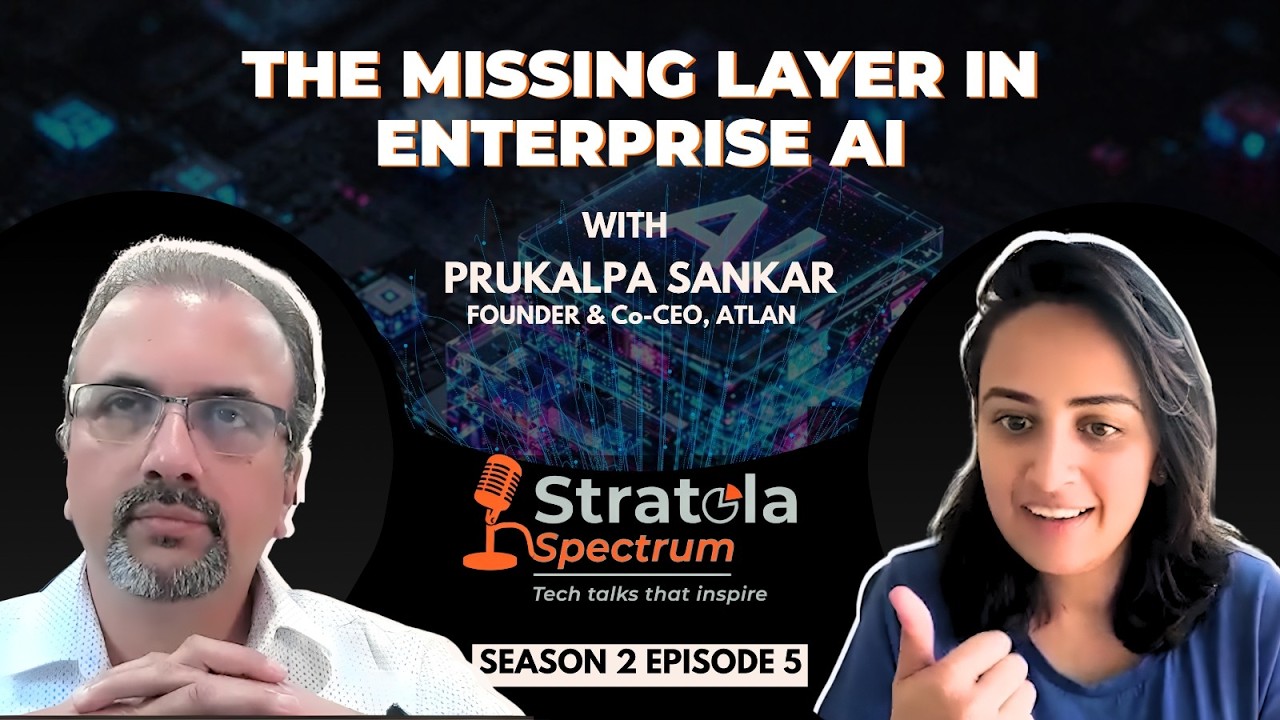

About This Episode
In Season 2 Episode 5 of Stratola Spectrum, Dinesh Chandrasekhar sits down with Prukalpa Sankar, founder and co-CEO of Atlan, to explore why context is the missing layer between raw data and reliable AI action — and why most enterprise AI deployments are failing because of it.
The conversation does not begin with models or infrastructure. Instead, it starts with a deceptively simple question: “Who are my top 10 customers?” Sales has one answer. Marketing has another. Finance has a third. The AI model itself is not confused; the real issue is that the underlying business context was never unified in the first place.
The conversation moves through several critical themes:
- Why AI today is valuable but not yet truly useful for enterprise deployments — and what that distinction actually means in practice
- Why metadata, lineage, and business glossaries are necessary foundations, but still insufficient for reliable production AI
- Why context for data and context for AI are fundamentally different problems that most enterprises still treat as the same thing
- How Atlan evolved from AI-assisted workflows to fully autonomous workflows, and what that operational shift actually looks like
- Why ontology is re-emerging as a production requirement rather than remaining only a knowledge-management concept
A significant portion of the episode examines what context actually means at a systems level. Prukalpa breaks it into five layers:
- User context
- Knowledge context
- Meaning context
- Semantic context
- Data context
Each layer contributes a different dimension of understanding that AI agents need in order to operate reliably. Most enterprises have invested in portions of the data context layer, but very few have built the meaning and knowledge layers above it. Those higher layers are ultimately what determine whether an AI system produces genuinely useful answers or simply confident but incorrect ones.
The discussion also explores the governance and freshness challenge surrounding enterprise context:
- Business definitions and policies constantly evolve
- Pricing models and operational strategies change over time
- Leadership turnover alters organizational priorities and terminology
- AI systems operating on outdated context quickly become unreliable
- Context must therefore be managed as a living asset with ownership, propagation rules, and versioning
Ultimately, this episode is not about which AI tools to buy or which models to deploy. It is about the organizational and architectural work required to make AI systems function reliably inside real enterprise environments.
Key Takeaways
The capability of AI models is not in question. The problem is that models do not understand your business. They do not know what your terms mean, how your teams interpret the same metric differently or what changed in your organization last month. Context is the layer that translates general intelligence into business-specific usefulness.
Having a well-maintained data catalog, business glossary and semantic layer puts an enterprise ahead of most. But these tools were built to help humans navigate data. They were not built to give an AI system the meaning it needs to answer a business question reliably. Building one does not give you the other. Enterprises need to understand this distinction before they assume their existing data infrastructure is AI-ready.
In the era of dashboards and bounded use cases, ontology was a good-to-have. In the era of agents with unbounded use cases, it is the map that allows AI to navigate a business. Without it, agents cross organizational boundaries, produce inconsistent answers and create more confusion than value. The renewed interest in ontology is not academic. It is driven by enterprises hitting this wall in production.
Business evolves continuously. When a pricing policy changes, every agent that touches pricing needs to know immediately. When strategy shifts, the context layer needs to reflect that shift before agents start producing outputs based on outdated reality. Context requires ongoing ownership, freshness standards, propagation rules and versioning. Treating it as a deliverable with a completion date is how context initiatives fail.
The hardest problems in taking AI from pilot to production are organizational. Who owns the context layer? Who approves updates when business definitions change? How do legal and compliance requirements get encoded? These questions do not have technical answers. They have governance answers. And most enterprises are not asking them early enough.
Every company has access to the same foundation models. What makes one company's AI meaningfully better than a competitor's is the context layer built on top. The organizational knowledge, the business definitions, the decision history and the institutional norms that are specific to how that company operates. That is the IP. And it needs to be protected, kept open and allowed to compound over time.