

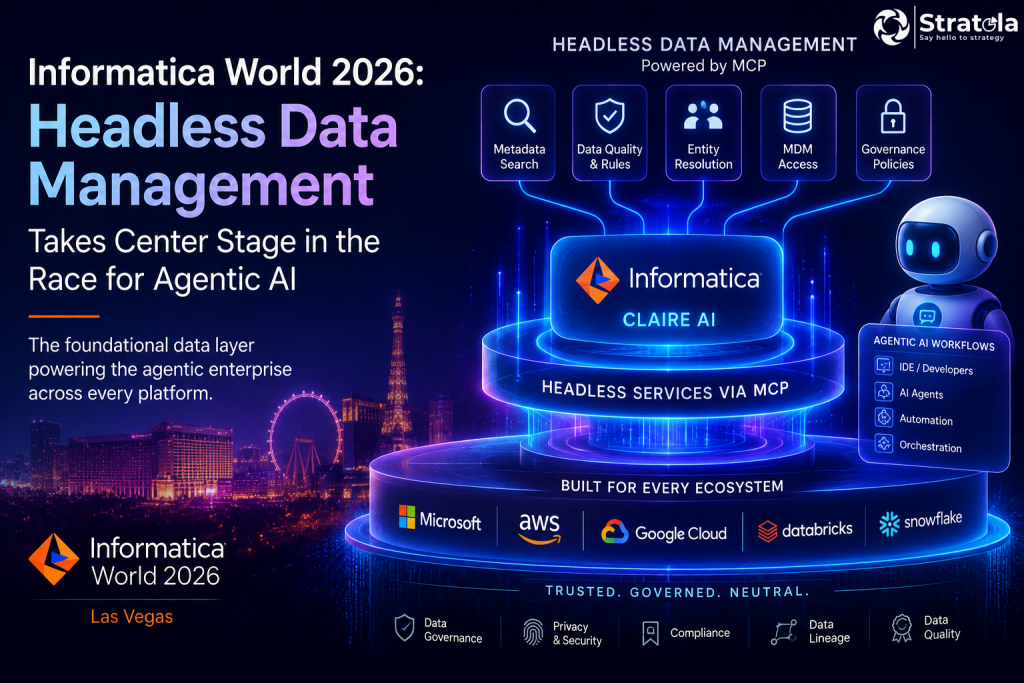
Last week, I got invited to attend Informatica World 2026 in Las Vegas. The conference was a significant moment for a company navigating one of the most consequential transitions in its history. Operating now as part of Salesforce, Informatica used this event to lay out a clear and coherent vision for what it intends to be in the agentic enterprise era. It wants to be the foundational data layer that powers the agentic enterprise. Whether you are running your AI workloads on AWS, Google Cloud, Databricks, Snowflake, or the Salesforce stack, Informatica wants to be the trusted data substrate beneath it all using “Headless Data Management”. Several of the product and partnership announcements made in Las Vegas represent genuinely smart moves that enterprise data leaders should pay close attention to. There are also some areas that need sharper definition as the platform matures, and those are worth naming honestly. This was a strong showing from a company that has earned its position at the center of the enterprise data conversation.
The “Switzerland of Data” Positioning
The principle behind everything Informatica announced at this event is neutrality at scale. The company’s product leaders describe the platform as the “Switzerland of data” and the “Swiss-army knife of data management,” and that framing is more than a marketing construct. It reflects an architectural stance that says Informatica will work with every hyperscaler, every data platform, and every AI framework without preferring any of them.
The breadth of the ecosystem announcements at this event made that philosophy tangible. Over two days, Informatica announced meaningful new capabilities across Microsoft, AWS, Google Cloud, Databricks, and Snowflake. Each announcement was distinct and purpose-built rather than a generic extension of the same integration pattern. That level of ecosystem discipline, executed simultaneously across five major platforms, is not easy to pull off and should be recognized as a genuine organizational capability. For enterprise data leaders who are managing multicloud and multi-platform environments, this neutrality has real practical value. The alternative is to build your data foundation on a platform whose incentives are aligned with a single cloud provider or a single data warehouse. Informatica is betting that enough enterprises will see the risk in that and choose the neutral option.
Headless Data Management Is the Right Architectural Bet
The single most important product direction to emerge from Informatica World 2026 is the Headless Data Management offering. The concept is straightforward and well-timed. Instead of requiring developers and data engineers to interact with Informatica’s platform through its own UI, Informatica now exposes its full capability stack as reusable, governed services accessible via Model Context Protocol (MCP). Any agent, IDE, or developer workflow can invoke Informatica’s data quality checks, metadata search, entity resolution, MDM access, and governance policies without building custom integrations.
Though an obvious choice given how the rest of the industry is moving, it is still the right architectural move for a platform that wants to be foundational rather than peripheral. The MCP standard is gaining real traction as the interoperability layer for agentic AI systems. Informatica is inserting itself into every agent workflow that touches enterprise data, regardless of which orchestration layer that agent runs on. The CLAIRE AI layer now operates in a fully headless mode, executing pipeline generation, quality rule application, MDM stewardship, and metadata enrichment from within any connected environment, including developer tools like VS Code and Cursor. One of the most compelling demonstrations at the event was a live demo of a developer building a compliance-ready pipeline entirely within their IDE, without leaving the environment.
It is worth noting that several headless capabilities are still rolling out across preview stages, with full general availability on various partner integrations planned through summer and Q4 2026. The roadmap looks credible and the direction seems clear, and that matters as much as what is shipping today when evaluating a platform of this scope.
The Ecosystem Partnership Announcements Are Smart and Strategic
The individual partnership announcements deserve closer examination because several of them reflect clever strategic thinking that goes beyond standard integration work.
The Databricks announcement spanned four distinct capabilities: headless IDMC integration with Agent Bricks via MCP servers, a purpose-built Named Connector for Databricks Lakebase optimized for OLTP data flowing into the agentic layer, a streamlined path for publishing MDM golden records directly into Databricks SQL with pre-configured schemas for Customer, Supplier, Product, and Location domains, and Unity Catalog tag extraction into Informatica’s own catalog. That last capability is particularly sharp. By federating governance tags from Unity Catalog into CDGC, Informatica is positioning its catalog as the enterprise-wide governance layer that sits above individual platform catalogs. That is an important architectural claim and, if executed well, a significant source of long-term platform stickiness.
The Snowflake announcement included being one of the first Snowflake ecosystem partners to deliver headless data management integration with Cortex AI. For enterprises building agents on Snowflake’s AI layer, being able to invoke Informatica’s governed data services directly within those agentic workflows without custom connectors is a meaningful capability. The row-level access policy propagation from Informatica’s Cloud Data Access Management framework into Snowflake Tables reflects a “build once, enforce everywhere” governance model that many enterprise data teams have been chasing for years. Iceberg table support, now generally available, extends this governance posture to open-format data architectures.
The Microsoft announcement covered two fronts simultaneously. Informatica’s headless IDMC MCP servers are now generally available within Microsoft Foundry, making metadata search, address verification, and data provisioning directly invocable by Azure customers building agents. On the analytics side, expanded Fabric support adds Mass Ingestion and Change Data Capture for Fabric Data Warehouse, enabling ingestion from more than 300 enterprise sources with incremental updates. It is one of the more complete partner announcements from the event because it spans both the data readiness and agent execution layers within a single ecosystem partnership.
The AWS integration brings Informatica’s MCP servers and CLAIRE agent skills into AWS Agent Registry and Amazon Quick, making Informatica’s metadata, data quality, and MDM capabilities discoverable and invocable within Amazon Bedrock-based agentic workflows. The framing around three root causes of enterprise AI failure, missing metadata context, fragmented master records, and point-of-entry data quality problems, is well-constructed and maps directly to where Informatica’s capabilities address real production pain.
The Google Cloud partnership extension brings CLAIRE GPT natively into Google Cloud delivery points and adds support for the Agent2Agent protocol, enabling CLAIRE agents to collaborate with agents across any vendor platform. The A2A protocol support, now planned for the Fall 2026 release, positions Informatica as an open participant in multi-vendor agentic architectures rather than a closed island. For enterprises building heterogeneous agent ecosystems, that interoperability commitment matters.
The Agentic MDM Story Deserves More Attention Than It Is Getting
IMO, one of the most substantive announcements at the event was Agentic Multidomain MDM, and the MDM keynote made a compelling case that master data management is moving from a back-office data hygiene function to a genuine AI prerequisite.
The operational reality is that agentic AI systems fail not because of the models but because they are operating on fragmented, ambiguous, and ungoverned data. An agent that cannot resolve whether two records in a customer database represent the same entity will take wrong actions confidently and at machine speed. Grounding probabilistic agents in deterministic, governed master data is the only reliable way to address that failure mode. The golden record becomes the anchor for agent accuracy.
The practitioner perspectives from Hilton and Arrow Electronics reinforced this point with real-world weight. Arrow Electronics’ data governance leader described consolidating 41 different internal definitions of the word “customer” down to a single governed standard, a process that took four months. That is precisely the foundational work that most organizations have deferred and are now discovering they cannot bypass as they push agents into production. The MDM session was one of the more intellectually honest moments of the event because it acknowledged that the path to agentic readiness runs through data foundations that many enterprises have underinvested in for years.
Areas That Informatica Needs To Improve
A balanced analyst read of this event would be incomplete without acknowledging three areas where Informatica has more work to do.
The first is execution fidelity between the stage narrative and the product. A number of the demonstrations on the event floor appeared to be design-stage Figma mockups rather than a working product. Product specialists on the floor were occasionally disconnected from the specifics of what was announced in the keynotes. A good example is “Context Map”. This was announced in a keynote, and even a couple of demos were shown on stage. However, none of the Informatica product experts at the expo hall knew about this terminology or what it meant. Every executive sounded excited about AI context, but none of the experts could show how that AI context is built in the platform. This is a gap that matters for a platform whose value proposition rests on enterprise trust. Closing the gap between the roadmap story and product reality will be important as Informatica moves into the proof-of-concept and evaluation cycles required for enterprise commitments.
The second is security. For a platform positioning itself as the governed, trusted data layer for enterprise agentic AI, the security architecture of the headless and MCP-based capabilities deserved more explicit attention in the keynotes and product sessions. Exposing data management capabilities as callable microservices across enterprise environments creates real questions about authentication at the MCP layer, audit trails for agent-invoked operations, and access boundary controls. Bringing security architecture into the main product conversation, rather than leaving it as an assumed property of governance, would strengthen the enterprise confidence story significantly.
The third is clarity on the Salesforce platform boundary. The joint narrative between Informatica, Data 360, MuleSoft, Tableau, and Agentforce is coherent at the vision level. The precise boundary between Informatica’s integration capabilities and MuleSoft’s, and the specific influence of Agentforce on CLAIRE’s AI product roadmap, would benefit from crisper articulation. Enterprise architects designing their agentic stacks today need more precision than the current framing provides. This is a natural consequence of a major acquisition still finding its organizational shape, and it is reasonable to expect that clarity will come in the months ahead.
Stratola’s Take
Informatica World 2026 presented a company that is making the right strategic calls at a pivotal moment. One might even say that this is what is expected of the company at this stage in its post-acquisition evolution. Even SAP made a few fast acquisitions and related announcements about its place in the new world of agentic data management. That doesn’t mean SAP’s execution will be the same as its strategic vision.
Informatica’s headless architecture bet is well-timed and architecturally sound. The ecosystem partnership announcements reflect genuine platform breadth and, in several cases, real competitive intelligence about where the market is heading. The repositioning of MDM as an AI readiness requirement is an insight that will age well as more enterprises discover the cost of bad master data in an agentic production environment. However, I will still caution that the traditional MDM adoption and implementation barriers haven’t been lowered yet. Significant product innovation is necessary to make MDM more accessible and easier to adopt and implement, enabling enterprises to truly try this model.
The neutrality positioning, while it carries inherent tension given the Salesforce relationship, is still the most defensible long-term strategy for a platform that needs to serve enterprises across every cloud and every data platform. Six months from now, if Salesforce adopts an SAP-like closed-ecosystem strategy, this advantageous positioning will fade quickly. Customers I spoke with also expressed concern about the lack of clarity regarding Salesforce’s influence on Informatica’s roadmap.
The areas that need sharper definition are real, but they are also addressable. The execution gap between the roadmap and the floor needs to be closed. Security needs a more prominent seat at the product conversation. The Salesforce boundary needs clearer articulation.
Informatica occupies one of the most structurally important positions in the enterprise data landscape. The agentic AI wave is creating exactly the kind of demand for governed, trusted, context-rich data that Informatica has been building toward for years. The platform is well-positioned to capture that demand. The work ahead is delivering on the vision with the consistency and precision that enterprise trust requires.