
At the second annual European FabCon in Vienna, Microsoft unveiled major enhancements to its Microsoft Fabric data analytics platform in front of 4,200+ attendees. What emerged was a bold evolution from unified analytics into a context-rich, real-time intelligence platform built for the AI era. The announcements ranged from new Graph and Maps capabilities to deep integration with Azure AI Foundry, alongside improvements in OneLake, developer tooling, security, and performance.
From Data Unification to AI Readiness
Just over two years since its launch, Microsoft Fabric has grown into a comprehensive SaaS data and analytics platform with over 25,000 customers, including roughly 80% of the Fortune 500. Initially, Fabric’s promise was to unify disparate data services on OneLake, a single logical data lake. This unified foundation was the “finish line” of past data strategies.
Now, as Jessica Hawk from Microsoft noted at FabCon, “centralizing data, once the finish line, is now the starting point” for AI projects. In 2025, AI readiness is less about simply aggregating data and more about organizing it. This means adding context, relationships, and real-time awareness so that AI agents and applications can reason and act on that data.
Microsoft Fabric’s evolution reflects this shift toward what Microsoft calls “connected, contextualized data.” In practical terms, this means incorporating capabilities like graph-based knowledge modeling, geospatial analytics, and digital twin support. All of this aims at capturing business context in addition to data itself.
Graph and Maps: Building Connected Intelligence
The headline innovations at FabCon Europe were undoubtedly Graph in Fabric and Maps in Fabric. These new previews add powerful ways to represent and analyze data relationships and location data natively within Microsoft Fabric.
Graph in Fabric provides a low-code way to model and explore relationships across enterprise data, effectively turning raw data into a knowledge graph. Built on proven technology from LinkedIn’s graph engine, it allows organizations to visualize and query complex relationships among customers, suppliers, products, or employees. Instead of seeing data as rows in tables, Fabric’s graph engine can represent data as nodes and edges, capturing how entities connect and influence each other in the business.
Why does this matter? In AI scenarios, understanding relationships is key to reasoning. A question like “How might a delay at Supplier X affect our top 5 customers’ orders?” is best answered by traversing a graph of supply chain relationships. With a highly scalable graph engine integrated into Fabric, users can uncover hidden linkages and feed those insights to AI models or reporting tools.
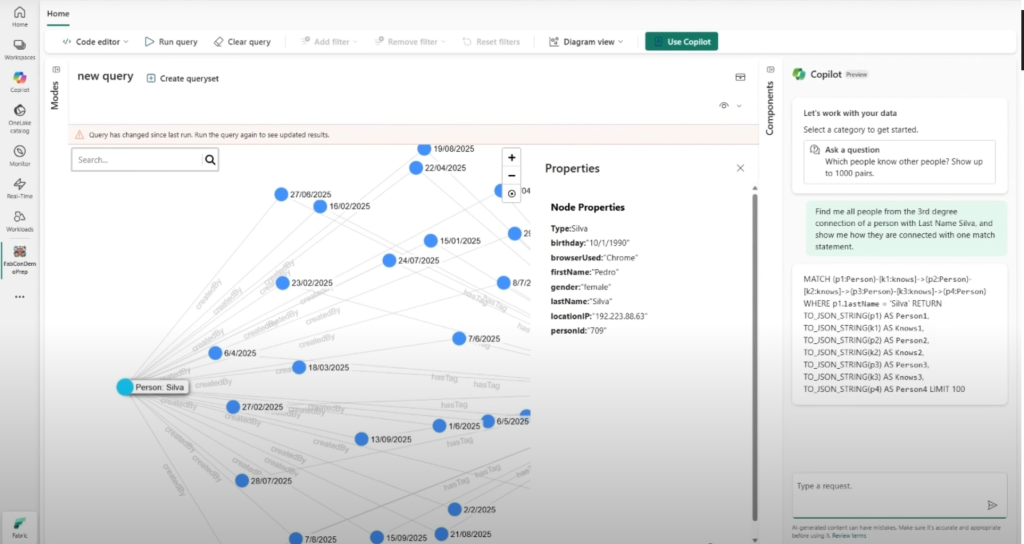
Microsoft also announced a partnership with Neo4j, whose managed service is now natively available as a Fabric partner workload. This dual approach shows Microsoft’s seriousness in graph analytics. Customers can start quickly with Fabric’s built-in Graph for common use cases, and if they need advanced graph algorithms, they can integrate Neo4j seamlessly.
Maps in Fabric brings native geospatial analytics to the platform, a natural complement to real-time and IoT data scenarios. This capability allows organizations to ingest and visualize massive streams of location data on interactive maps, enabling location-aware decision making in real time. This goes beyond simple map visuals in a BI report. Fabric’s Maps capability is built to handle high volumes of spatial data and overlay them on maps for instant insight.
By integrating streaming analytics with geospatial mapping, Microsoft Fabric can support use cases like tracking global supply chain shipments live on a map, monitoring geographically distributed assets with real-time alerts, or analyzing regional patterns in customer behavior as they unfold. Microsoft has also partnered with ESRI to integrate advanced geospatial analytics into Fabric, ensuring that organizations needing sophisticated spatial analysis can leverage ESRI tools alongside Fabric’s native capabilities.

OneLake: The AI-Ready Foundation Grows Stronger
At the core of Microsoft Fabric is OneLake, the single logical data lake that underpins all Fabric workloads. Microsoft announced a series of OneLake enhancements aimed at further simplifying data integration, improving governance, and enabling new ways to access data in place.
Fabric is doubling down on its “zero-ETL” ethos with new OneLake mirroring previews for Oracle databases and Google BigQuery. This allows near real-time access to external data without moving or duplicating it. OneLake Shortcuts for Azure Blob Storage are now generally available, extending Fabric’s reach across clouds. Together, shortcuts and mirroring mean OneLake can unify data across AWS, Google Cloud, and on-premises virtually.
A new preview of OneLake shortcut transformations can automatically convert semi-structured files like JSON and Parquet into Delta tables on the fly. This means users can drop raw data files into OneLake and immediately treat them as tabular datasets for analytics, without manual ETL.
Microsoft announced the general availability of OneLake integration with Azure AI Search. OneLake can now be indexed by Azure’s cognitive search so that AI chatbots and agents can retrieve enterprise data securely. This capability is surfacing in the Azure AI Foundry portal as well, making it easier to ground LLM-based agents on OneLake content.
Fabric is previewing OneLake Security, an industry-first unified data permission model across the lake. OneLake Security lets data owners define access controls down to row and column level in one place, and have those enforced consistently whether data is accessed via SQL, Spark, or Power BI. Microsoft introduced a new “Secure” tab in the OneLake catalog for managing these permissions centrally, while a “Govern” tab provides a one-stop view for data cataloging, lineage, and compliance.
Developer Experience: New Tools and CI/CD
Microsoft announced a suite of developer experience improvements at FabCon Vienna, indicating that the company is listening closely to developer feedback and aiming to remove friction from building on Fabric.
The Fabric Extensibility Toolkit is an evolution of the earlier Workload Development Kit, now reimagined to let developers create their own custom Fabric items with minimal hassle. Third-party or in-house developers can build plug-in components that run within Fabric, with the toolkit handling much of the boilerplate integration, UI, and security model.
Model Context Protocol (MCP) is a developer-focused protocol for AI-assisted code generation and item authoring in Fabric. Microsoft is embedding Copilot-like assistance directly into the developer workflow for Fabric. MCP provides templates and best-practice instructions, and integrates with VS Code and GitHub Codespaces to help generate code or configuration for Fabric APIs.
Responding to a top ask from enterprises, Microsoft announced general availability of Git integration and deployment pipelines across nearly all Fabric artifacts, including lakehouses, data warehouses, Power BI reports, data pipelines, and even the new Fabric data agents. This means teams can now apply standard DevOps practices to their Fabric content.
Microsoft Fabric’s User Data Functions have reached general availability, making it easier to encapsulate logic and share it across queries. The Fabric VS Code extension is now generally available, offering a rich offline development experience. To aid multitasking, Microsoft added horizontal tabs for open items and support for multiple active workspaces in the UI, plus a new Object Explorer panel.
Enterprise-Grade Security and Performance
Microsoft used the FabCon stage to highlight Fabric’s progress in security and performance, introducing new controls and improvements that address enterprise requirements.
Fabric now supports Azure Private Link for secure access, meaning all Fabric service traffic can be kept on private Azure networks. Outbound access protection for Spark ensures Spark clusters in Fabric can be restricted from calling external endpoints. Workspace-level IP filtering will enter preview in the coming weeks. Customer-Managed Keys are now generally available for Fabric, allowing organizations to control the encryption keys for their data at rest.
To address the risk of noisy neighbors and cost overruns, Microsoft announced “surge protection” features for Fabric capacities. Now generally available for background jobs and in preview for interactive workspace jobs, surge protection lets admins set consumption limits to prevent any one workload from overwhelming the capacity.
The Fabric engineering team has delivered over 40 optimizations to the Fabric Data Warehouse engine since August 2024, yielding a 36% performance improvement on benchmark queries. This is significant for customers coming from Azure Synapse or SQL Server, signaling that Fabric’s cloud data warehouse is not only feature-rich but also fast and getting faster.
An end-to-end migration experience for Azure Synapse dedicated SQL pools to Fabric is now generally available. This wizard-driven tool can migrate both metadata and data, with an intelligent assessment to guide any needed code changes and AI-powered assistance for troubleshooting.
Open Ecosystem: Partners and Snowflake Integration
One of the more refreshing themes from FabCon was openness. Microsoft announced the general availability of partner solutions natively in Fabric from companies like ESRI, Lumel, and Neo4j. These appear as additional workload options in the Fabric portal, installable with one click. This effectively turns Fabric into a platform marketplace for data apps.
Perhaps the most eyebrow-raising integration is with Snowflake, a rival analytics cloud. OneLake now works seamlessly with Snowflake’s engine via open formats like Apache Iceberg and Parquet. Snowflake can read and write tables directly in OneLake with no data copy using Iceberg format. OneLake shortcuts can point to Snowflake data on other clouds. Iceberg REST APIs were introduced so Snowflake can query OneLake Iceberg tables as if they were its own.
The result is a truly bi-directional integration where Fabric and Snowflake share a single copy of data on OneLake, each using it with their preferred engine, and changes stay in sync. This is all about customer choice and eliminating data silos. Microsoft is basically saying keep using Snowflake if you want, but put the data in OneLake so you can also use Fabric services on it.
Fabric + Azure AI Foundry: Complete Data and AI Ecosystem
A recurring theme throughout these announcements is how Microsoft Fabric ties into the AI stack, notably via integration with Azure AI Foundry. Azure AI Foundry is Microsoft’s emerging platform for designing and managing AI applications and custom AI agents. While Fabric handles the data side, Foundry handles the AI model and application side.
Microsoft introduced Fabric Data Agents earlier this year as AI-powered connectors that can retrieve and reason over data in OneLake. At Vienna, the message was that developers can now use Azure AI Foundry’s Agent Service to incorporate Fabric data agents as knowledge sources for conversational AI agents. An AI agent built in Foundry can ask a Fabric data agent questions, get results from OneLake with understanding of the data’s structure and context, and use that to formulate accurate, grounded responses.
Azure AI Foundry is being natively melded with Fabric’s tools. The OneLake data discovery and security features are available through the Foundry portal, so AI developers can easily pull in OneLake data. Both platforms share an emphasis on governance, with Fabric focusing on data governance and Foundry on AI performance and ROI governance.
Microsoft’s pitch is that data and AI belong together. “Every project is a data project” in AI, and success comes from reducing complexity by having a unified platform. For tech executives, this unified approach promises to eliminate complexity, speed adoption, and align AI initiatives with strategic goals.
Stratola’s Take
The announcements at FabCon Vienna 2025 illustrate Microsoft Fabric’s rapid maturation from a promising unification of data tools into a holistic, AI-centric platform. Microsoft is steering Fabric towards what organizations will need in the coming years: real-time, contextual intelligence at enterprise scale, developed and delivered with the agility of modern software practices.
For senior technology leaders, the implications are significant. Fabric’s trajectory suggests that investing in a unified platform rather than a patchwork of point solutions can accelerate AI innovation. When your data lake, data engineering, BI, and AI agent development all share one canvas, the result is faster iteration and a “compounding” of insights.
At Stratola, we have been saying it very clearly that with more and more AI disruptions happening all around us, enterprises should definitely choose data platforms over point solutions. Microsoft is playing right into our words. With Fabric, Microsoft is delivering a platform that connects data, intelligence, and action in a single ecosystem. The FabCon 2025 updates all reinforce that Fabric is ready for real-world, AI-fueled workloads today, while laying the groundwork for the next generation of AI applications. It is a bet on data-centric AI, where a richly organized data foundation is the differentiator between experiments that fail and AI that transforms businesses.