

About This Episode
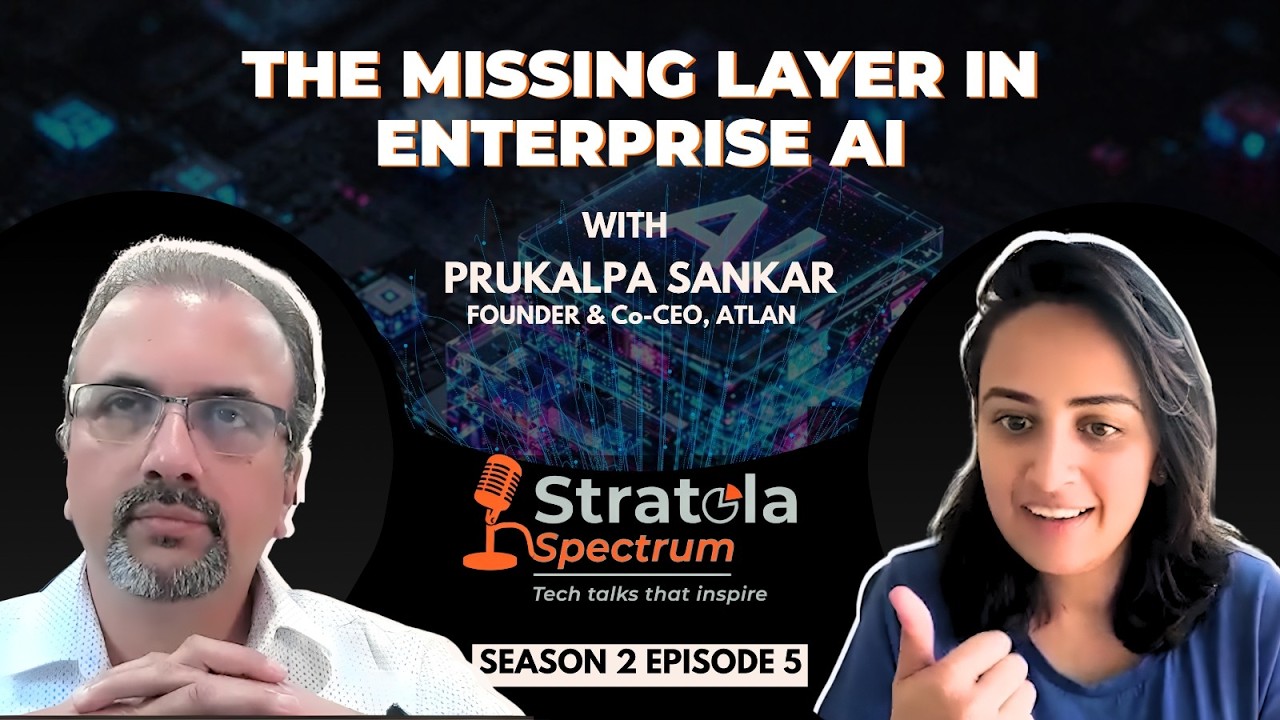
In this episode of Stratola Spectrum, Dinesh Chandrasekhar, Chief Analyst, Stratola, speaks with Girish Muckai, Co-founder and CEO of Rockfish Data, about why synthetic data is becoming a critical pillar for building reliable AI systems.
As AI models become more powerful, the industry is running into a less glamorous bottleneck: data. Not just “more data,” but the right kind of data. Real enterprise data is often locked behind privacy, compliance, and retention constraints. Even when data exists, it is frequently sparse in the exact scenarios that matter most, like fraud, outages, anomalies, edge cases, and rare operational failures.
Girish breaks synthetic data down into two core problems it solves:
- Privacy-safe data sharing
- Data sparsity and scenario coverage
The discussion goes beyond definitions and digs into how modern generative methods (GANs, transformers, diffusion, state-space models) learn distributions and correlations to produce data that is statistically similar but not a replica of the original. The conversation also covers how to measure whether synthetic data is actually good, through fidelity metrics, memorization and linkability checks, and most importantly, downstream validation where models trained on synthetic data are compared against real-world outcomes.
A key theme is control. Synthetic data is not only about privacy compliance. It can be deliberately shaped to generate more of what you care about: rare events, “what-if” business disruptions, and balanced datasets to mitigate bias. That is why synthetic data is increasingly relevant not only for model training, but also for testing agentic AI systems before they hit production, where predictability, trust, and explainability become non-negotiable.
If you work in regulated industries, operational AI, AI agents, or enterprise platforms where real data cannot move freely, this episode is a practical look at why synthetic data is no longer optional.
Key Takeaways
Data is the real bottleneck for AI, not models. Girish frames models like a car, but data is the fuel. Without enough high-quality, representative data, AI performance and reliability hit a ceiling fast.
Synthetic data exists to solve privacy plus sparsity together. Enterprises cannot share proprietary data due to compliance and risk, and many scenarios are missing or rare. Synthetic data aims to be safely shareable while still realistic enough to train and test models.
Synthetic data must prove fidelity and privacy with measurable checks. They validate via statistical similarity (distributions, correlations, time dependencies) and downstream performance (model trained on synthetic vs real). Privacy is checked via memorization and inference/linkability style tests to ensure it is not reconstructable.
It is not just “more data,” it is “more of the right scenarios.” Synthetic data helps amplify rare events like fraud, outages, anomalies, and what-if disruptions. This is more valuable than generating huge volumes of normal-looking data.
Big opportunity is production-ready agents and unbiased training sets. Girish highlights the “demo to production death valley” because agents lack test coverage across real scenarios. Synthetic data can create controlled scenario suites, reduce bias by rebalancing patterns, and improve trust, explainability, and predictability.