
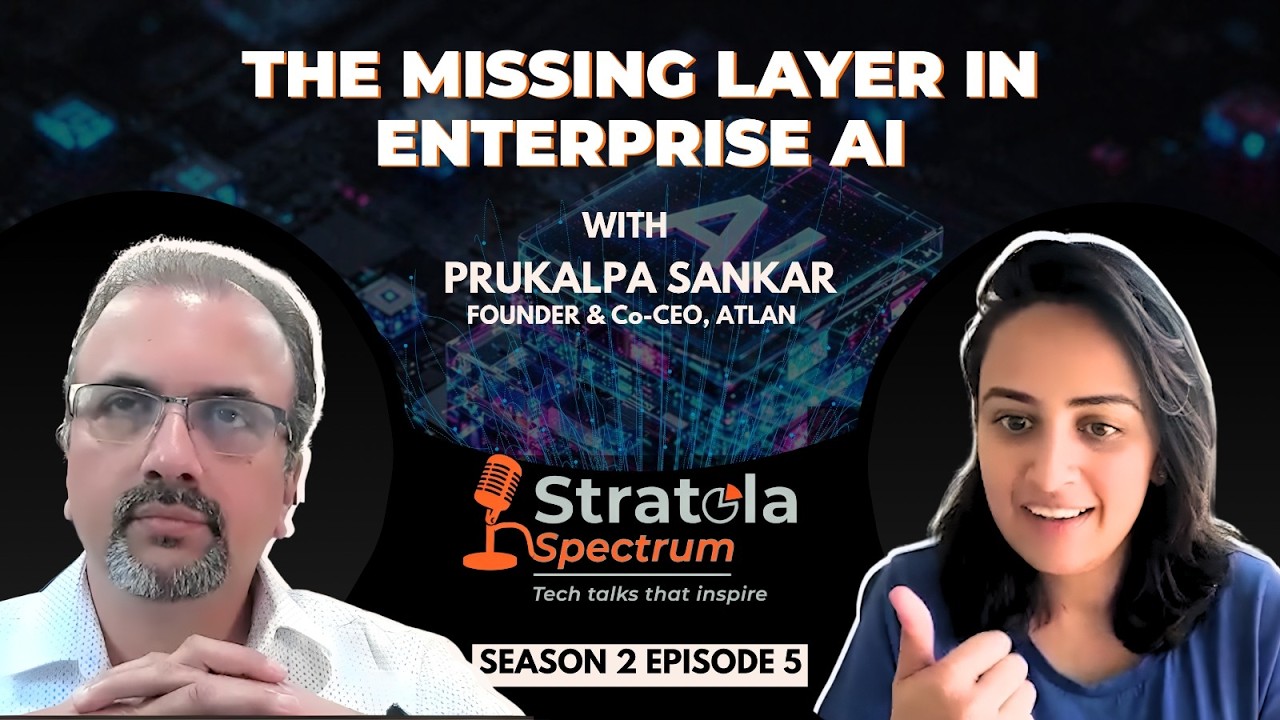

(Header image above was generated with GPT-5 after 15 or more unsuccessful tries. This wasn’t even the one I was going for but I gave up after 20 minutes of making it remember every single thing I had already told it before. I had to add the Stratola logo manually later on as it kept messing with the image I gave it. Wasn’t a great first experience at all!)
Yesterday, OpenAI officially launched the much-anticipated GPT-5 in an event that started with some lacklustre demos. For a lot of us in the industry, the bar for such launches is automatically raised due to intense competitive pressures as well as the pace at which innovations are happening all around us. So, for those of us who expected something truly revolutionary, the launch event fell a bit short. However, it seems like a step up in terms of the next release, which builds on what we are already elated about. The event, led by CEO Sam Altman and the OpenAI research and engineering teams, showcased the model’s advanced reasoning, improved factuality, and broad accessibility. The launch was packed with live demos, technical deep-dives, and real-world stories that highlighted GPT-5’s transformative potential across industries.
A New Standard in Reasoning and Reliability
The core of GPT-5’s advancement is its “reasoning paradigm.” Unlike previous models that forced users to choose between fast, shallow answers and slower, more thoughtful ones, GPT-5 dynamically adapts its depth of reasoning to the task at hand. This means users get the right balance of speed and intelligence, whether they’re asking a simple question or requesting deep analysis. OpenAI’s research team emphasized that GPT-5 is their most powerful, reliable, and robust model yet, outperforming previous generations and competitors on a wide range of academic and real-world benchmarks.
Demonstrations: Coding, Learning, Writing, and Health
The event featured a series of live demos that illustrated GPT-5’s capabilities:
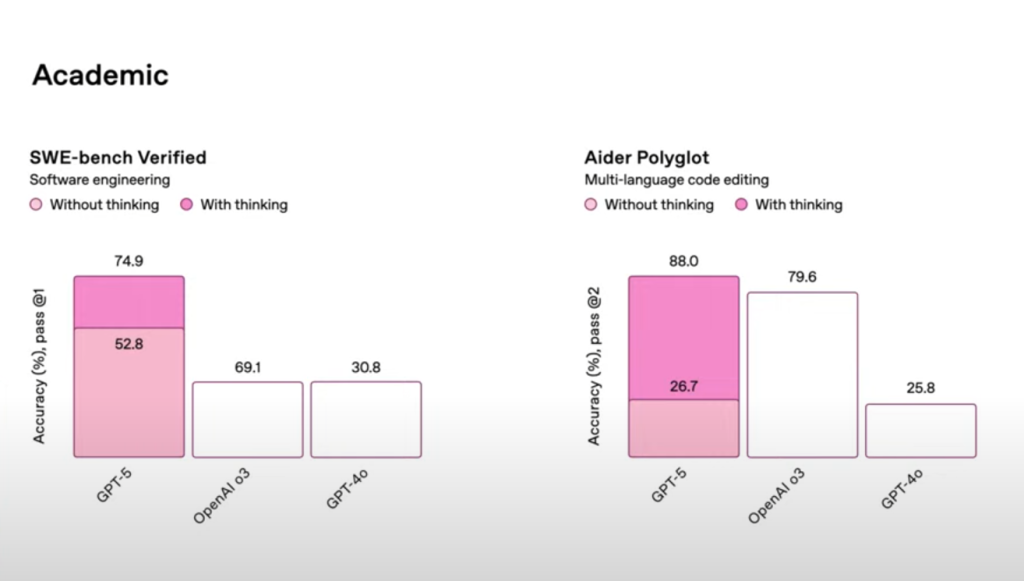
Coding: GPT-5 set new records on benchmarks like SWE-Bench and Aider Polyglot, excelling at both Python and multi-language programming tasks. The model demonstrated its ability to generate complex, modular, and aesthetically pleasing code for applications like interactive dashboards and educational games. Its agentic capabilities allow it to autonomously plan, execute, and debug code, making it a true partner for developers.
Learning: GPT-5’s reasoning abilities shine in educational settings. In one demo, the model explained complex physics concepts, generated interactive visualizations, and created engaging learning tools on the fly. Its ability to adapt explanations to the user’s level and provide step-by-step guidance makes it a powerful tutor across subjects.
Writing: The writing demo highlighted GPT-5’s improved prose, emotional intelligence, and nuance. Compared to previous models, GPT-5 produces more genuine, context-aware, and resonant responses, whether drafting emails, stories, or even heartfelt eulogies for its predecessors.
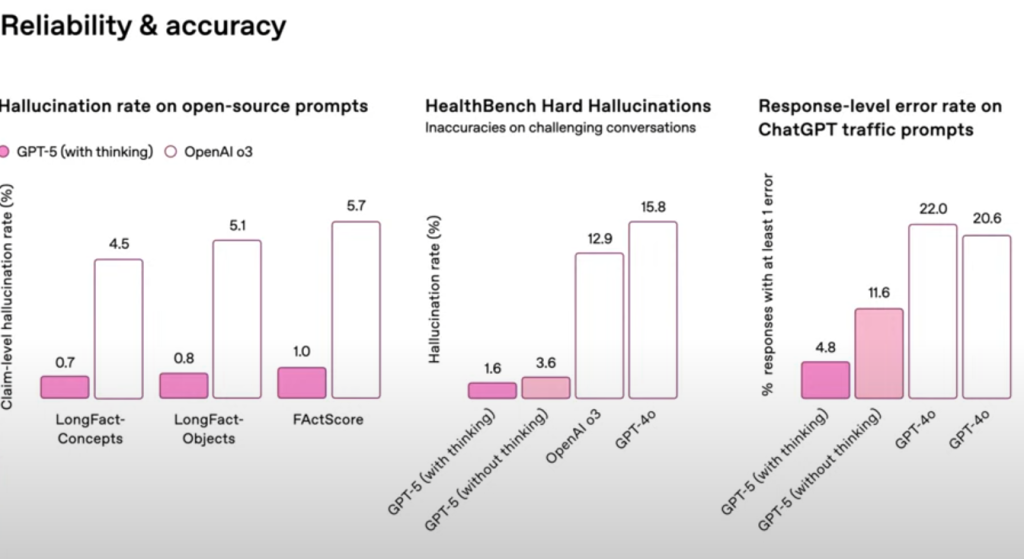
Health: One of the most moving segments featured a real user’s story about navigating a cancer diagnosis with the help of ChatGPT. GPT-5’s enhanced factuality and clarity in health-related queries empower patients to understand medical information better, weigh treatment options, and advocate for themselves. The model outperformed previous versions on Health Bench, an evaluation built with input from hundreds of physicians.
Expanded Accessibility and Personalization
For the first time, GPT-5 is available to all ChatGPT users, including the free tier. Free users start with GPT-5 and transition to GPT-5 Mini after reaching usage limits, while Plus and Pro subscribers enjoy higher limits and access to GPT-5 Pro for even deeper reasoning. Enterprise and EDU customers will also have GPT-5 as their default model, with generous rate limits for organizational use.
Personalization features have also been expanded. Users can now customize chat colors, select from a range of ChatGPT personalities (from supportive to sarcastic), and benefit from enhanced memory features. Notably, ChatGPT’s memory has been significantly improved. The model can now remember more about users over time, making interactions increasingly personal and context-aware. For example, ChatGPT can help plan schedules by integrating with Gmail and Google Calendar, automatically pulling in relevant information and suggesting optimal times for activities like workouts or meetings. This deeper integration means ChatGPT becomes a more proactive and helpful assistant in daily life, as though it is not the case already for a lot of us.
Voice and Multimodal Upgrades
Voice capabilities have taken a leap forward. The new voice model sounds more natural and conversational, with the ability to translate between languages smoothly and respond in concise, comprehensive, or even single-word answers as requested. A new “study and learn” mode guides users step-by-step through topics, making language learning and exam prep more interactive. Video input is now supported, allowing ChatGPT to “see” what the user sees and provide richer, context-sensitive assistance.
API Improvements and Developer Tools
For developers, GPT-5 introduces three models: GPT-5, GPT-5 Mini, and GPT-5 Nano, each optimized for different performance and cost needs. The API now supports a longer context window (up to 400K tokens), enabling applications to handle much larger documents and conversations. New features include:
Custom Tools: Developers can now define custom output formats using regular expressions or context-free grammars, making GPT-5 more adaptable to specialized workflows.
Tool Call Preambles: The model can explain its actions before executing tool calls, improving transparency and trust.
Verbosity Controls: Developers can set how concise or detailed the model’s responses should be.
Reasoning Effort Parameter: This allows fine-tuning of how much “thinking” the model does, balancing speed and depth for different use cases.
GPT-5’s agentic abilities are particularly notable. It excels at tool calling, multi-step reasoning, and following complex instructions, making it ideal for sophisticated automation and enterprise applications.
Enterprise and Industry Impact
OpenAI highlighted real-world deployments of GPT-5 across industries. In life sciences, companies like Amgen are using GPT-5 for deep reasoning over scientific literature and clinical data, accelerating drug discovery. Financial institutions such as BBVA have seen dramatic improvements in analysis speed and accuracy, with tasks that once took weeks now completed in hours. In healthcare, insurers like Oscar leverage GPT-5’s clinical reasoning to map medical policy to patient conditions more effectively. And, the U.S. government announced that two million federal employees will gain access to GPT-5, aiming to deliver faster, better public services.
Safety, Training, and Research
A major focus of GPT-5’s development was safety. The model is significantly less prone to hallucinations and deception, thanks to overhauled safety training and the introduction of “safe completions.” Instead of simply refusing risky prompts, GPT-5 aims to maximize helpfulness within safety constraints, providing partial answers or guidance when appropriate and always explaining refusals.
OpenAI also shared insights into their new training methodology, which leverages synthetic data generated by previous models to create high-quality, targeted training sets. This recursive approach is seen as a step toward self-improving AI systems.
Pricing and Availability
GPT-5 is available immediately via the API, with pricing set at $1.25 per million input tokens and $10 per million output tokens for the main model. Mini and Nano variants offer even faster, more affordable options for developers with high-throughput or latency-sensitive needs. GPT-5 Mini and Nano, while smaller, still outperform many previous models and are designed to make advanced AI accessible for a broader range of applications and budgets.
OpenAI’s Vision for the Future
The event closed with reflections from OpenAI’s leadership and research teams. They emphasized that GPT-5 is not just a technical milestone but a glimpse into the future of AI as a deeply integrated, empowering tool for individuals and organizations. The team acknowledged that while GPT-5 sets new standards in reasoning, reliability, and safety, there is still much to learn and improve. Their ongoing mission is to better understand deep learning, steer it responsibly, and ensure its benefits reach as many people as possible.
OpenAI’s president, Greg Brockman, and chief scientist, Jacob, both highlighted the collaborative spirit and dedication of the team behind GPT-5. They reiterated that the breakthroughs seen in GPT-5, such as dynamic reasoning, agentic coding, and safer interactions, are early signs of what’s possible as AI continues to evolve.
Stratola’s Take
We can expect more such advancements to come at a more frequent pace, given the competitive landscape we have. To add to that, we also have to consider the political ramifications of what is coming out of the Chinese market, as well as how tightly/loosely we align with the whole open source movement. All these factors will dictate the next set of priorities for such LLMs. Currently, trust issues are proving detrimental to adoption across a large set of enterprise use cases. In that regard, OpenAI’s focus on reducing hallucinations and improving the overall safety of their offering is a welcome thing.
The next wave of AI app innovations will likely depend on how well LLMs can code and how much agentic automation can dominate this segment. Claude Code has created quite the impact across the development community recently. Now, it remains to be seen if GPT-5 can give it a run for its tokens! This type of healthy competition within the tool segment is what will drive more productivity across developers, driving super-awesome innovations to market super-fast. I am waiting to see some of the industry benchmark evaluations emerge in the coming days.
OpenAI’s choice to deprecate all previous models and make GPT-5 instantly available universally to all users is a killer move. This will drive a fantastic network effect and increase adoption. Also, increasing the focus on developing more agentic capabilities will be crucial for any LLM’s domination in the market. We will soon transition away from this prompting mode of working with LLMs. Context and long-term memory are going to be key factors in this ongoing competition.
As for the healthcare angle in the launch event, I am not sure if it is strategic or not. On one hand, we have heard Sam Altman himself say that he would prefer a human doctor over ChatGPT – “I really do want a human doctor. ChatGPT today, by the way, most of the time, is a better diagnostician than most doctors in the world. There’s all these stories on the internet of like, ChatGPT saved my life… and yet people still go to doctors. Maybe I’m a dinosaur here, but I really do not want to trust my medical fate to ChatGPT with no human doctor in the loop.” With that said, if you can win healthcare, the trust conversation is over. But, it is going to be a while. I just hope that ChatGPT doesn’t become the thing that doctors wished patients didn’t have access to – webMD!!
The immediate adoption of GPT-5 across major vendors like Microsoft and Snowflake goes on to show the respect and adoration that the market has for OpenAI. However, OpenAI needs to treat the market with the same sense of respect. This doesn’t feel like a major update but more like a point release. See my very initial comment on how I had to struggle with image generation. While it was able to generate the text within the image correctly, it seriously sucked at remembering the few requirements I had for the image. It kept messing it up further as the context became larger. Just tells me that we still have miles to go. Forget AGI for some time now.