

A couple of weeks back, I was invited as an analyst to attend the Microsoft Ignite 2024 event in Chicago – a massive event that had over 14,000 attendees from across the world. More than the scale of the event, it was also the number of exciting announcements across the AI and data landscape that looked monumental – over 80+ new products and capabilities! Within just a few weeks from when Marc Benioff made a huge splash with Agentforce, this event from Microsoft had a lot to contend with. Satya Nadella wasn’t playing it soft either. Within a minute or so into his keynote, he launched into Microsoft’s view of the agentic AI world and started firing off a series of announcements across the Microsoft Fabric platform and didn’t stop for the next 3 hours! The AI world got a lot more real, pragmatic and purposeful with Microsoft’s approach to empowering all personas across the organization with AI-powered capabilities and skills.
Microsoft has a unique advantage
Across all industries, two of the most common areas where AI has been absolutely impactful are – employee productivity and customer engagement. And Microsoft has an absolutely unique advantage with tapping into both of those segments. With over 400 million paid Office 365 seats across the globe, launching Microsoft Copilot into that ecosystem to enable Excel, Word, Teams and other Office 365 users was a great strategy. Copilot users have seen tremendous productivity gains with tasks such as document/emails summarization, capturing meeting notes and creating action items, data analysis of their excel data, creating entire slide decks from just an idea, or even creative writing assistance. Now, in the latest set of new product announcements, Microsoft has expanded this universe with an entire army of agents to augment these capabilities with agentic actions and automating workflows. “What Lean did for manufacturing, Copilot will do for knowledge workers”, said Nadella.
Security-first approach to GenAI / Agents
When the keynote starts off with their security-first approach, you know that Microsoft isn’t playing around with new toys – they mean real business for enterprises. Nadella spoke proudly about Zero Day Quest – the largest public security research event in history. This event, which focuses on AI and cloud security, will offer the largest award pool in the industry at $4 million, in addition to an existing $16 million annual bounty program. This competition aims to attract the world’s best security minds to tackle high-impact scenarios critical to Microsoft’s customers’ security, with award multipliers.
Data privacy and security in the AI world
One of the biggest concerns across enterprises implementing GenAI applications / building agents is data leakage. Data privacy and security must hog the limelight when it comes to preventing PII / PHI data or other sensitive data from being fed into LLMs or allowing agents to access such information. However, the right set of guardrails are largely absent in today’s GenAI / agentic implementations and this should be a cause for great concern. Microsoft brings in such controls into its 365 world with the introduction of Microsoft Purview capabilities for its 365 Copilot. This will limit detecting sensitive information leakage, prevent accidental oversharing of sensitive data, detect and prevent risky or malicious usage/prompts within 365 Copilot, and more. While a lot of this is still in preview, this is a fantastic start to encourage enterprises to start adopting such best practices for data protection.
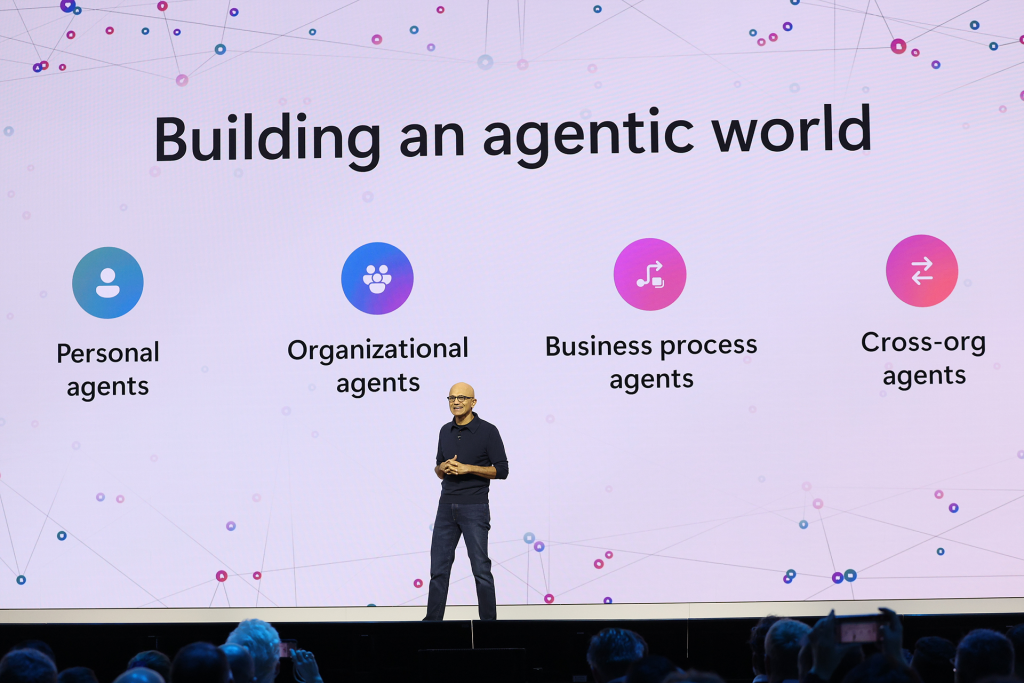
It’s an agentic world!
There’s no denying that agents are a definitive way to take automation to the next level in areas like employee productivity, employee engagement, customer support, etc. Microsoft isn’t experimenting just with a single area – it has launched a full-blown agentic army across its entire spectrum of offerings within Office 365, Dynamics, Azure, Databases and more. The Microsoft Copilot ecosystem has exploded into such a huge array of agents –
- Agents within Sharepoint can analyze specific Sharepoint content / folders and offer instant summarized insights about the content to employees. Not only can you quickly create such agents but you can share them across emails, chats, and meetings with users being able to ask these agents questions and get real-time responses.
- Agents within Teams can enable various collaborative tasks between employees. Facilitator agents can work as meeting note-takers within meetings. In chats, these agents can summarize active conversations and augment the chat with real-time information. The Interpreter agent can enable live-translation across nine languages so that global team members can speak in their own language and the agent can handle the live translation of the content. There is even the concept of the agent possibly using your own voice for the translation. There is also the idea of a Project Manager agent, which can create, manage, and simulate entire project plans across various teams. All of these agents are still in preview.
- The Employee Self-Service Agent in Microsoft 365 Copilot Business Chat (BizChat) will expedite answers for the most common workplace policy-related questions and will take action on key HR and IT related-tasks. From BizChat, users can retrieve benefits and payroll information, start a leave of absence, request a new laptop with IT and even get assistance for Microsoft 365 products. This is also still in preview.
- 365 Copilot is widely and easily available within all parts of the Office 365 suite as well – Word, Excel, Powerpoint, Outlook, Notes, Teams etc. This makes agentic automation more easily available for a lot of tasks right from some of the most widely used office productivity products across the globe. There is also a 365 Copilot for Microsoft 365 Administration Centers (MAC) that automates a variety of routine IT admin tasks. There are also 10 new agents in MS Dynamics 365.
- Copilot studio is also featuring several new and exciting agentic capabilities in preview mode. You can now create autonomous agents that can act on your behalf for a range of tasks such as receiving an email, responding to events, recording and uploading a file, etc., all without the need for any human intervention at all. Copilot Studio also features a brand new agent library that features several agent templates that are readily customizable and usable within the studio for various common agent tasks.
- Microsoft 365 Agents SDK – Developers can now use this SDK to create multi-channel agents across Teams, web, Microsoft Copilot and more. Ths SDK can also tap into AI services from Azure AI Foundry as well as from other vendors. This is also in preview mode with limited capabilities for now.
- Azure AI Foundry is the one-stop shop for everything you need related to agents – deesign, customize, and manage agents from a single place. It enables access to hundreds of models, pre-built AI app templates, a new SDK, and more.
- Azure AI Foundry integrations – This will bring Copilot Studio and the Azure AI Foundry a lot closer in that agents built in Copilot Studio can now access more than 1800+ models available within the Azure catalog. While this is still in preview, this is definitely a great step in democratizing AI agent building by allowing the developer to access industry-specific models as needed.
- Copilot Actions are how you can easily delegate tasks to Copilot – whether it be following up on a deliverable, asking for status updates, compiling weekly reports or more. The prompt templates for these Actions are easily customizable and can be either automated or even triggered on specific events.
- Copilot Analytics answers the most important question today – how do I measure ROI on my agentic implementations or automations? With a rich dashboard of key metrics and measurements, Copilot Analytics allows you to track Copilot readiness, adoption, impact, etc.
Fabric evolves into a serious data platform
When Microsoft Fabric was announced last year and the product became GA late last year, it was still lacking in a lot of enterprise features that were necessary to take it to the next level. With the explosion of the AI app economy all around, Microsoft Fabric positions itself as an ideal data platform that not only has a data lake but a robust feature set that includes a data catalog, multiple types of workloads including autonomous databases, a comprehensive Copilot ecosystem, support for a wide range of data types including real-time streaming data, analytical engines, vector search, etc.
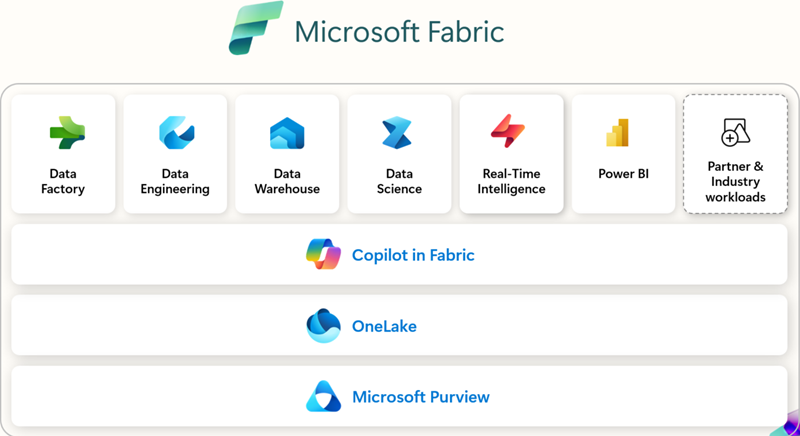
Here are some of the most noteworthy things about Fabric that I loved –
- Fabric Databases – This is the newest workload on Fabric (in preview). Augment your AI app development with self-provisioning, self-securing, autonomous databases. SQL Database in Microsoft Fabric is the first database that will be coming to Fabric under this workload. Lots of exciting features such as auto-replication into OneLake, for instant availability of data to the Fabric anaytical engines, vector search support enabling new age use cases such as RAG, auto-optimizing and auto-scaling databases, Copilot support for converting natural language queries into SQL, and a unified data governance and security layer across all of Fabric.
- Open Mirroring in OneLake – This allows you to bring in change data from any data provider easily into OneLake by writing to the Mirrored database. This capability ensures that such data is made available for analytics in a timely manner.
- OneLake Catalog – Data governance is a fundamental criteria for evaluating any data platform, particularly, when you are dealing with multiple data teams or domains across the enterprise. OneLake Catalog offers comprehensive data governance capabilities like data discovery, manage and recommend trusted data, classification and labeling, track data lineage, and manage permissions. OneLake catalog value can be extended to the Microsoft Purview data governance solution, Unified Catalog, which offers the data office, data stewards, and data owners advanced governance capabilities, including data quality and a global catalog for the heterogeneous data estate.
- SQL Server 2025 is an enterprise-ready vector database that will generate and natively store vector embeddings, enabling you to run generative AI models using your own data. Copilot in SQL Server Management Studio (SSMS) will streamline SQL development by offering real-time suggestions, code completions and best practice recommendations.
- Fabric Real-Time Intelligence is GA now. This is one of my favorite parts of the overall Fabric ecosystem. As Fabric starts to position itself as a serious data platform, the Real-Time Intelligence workload is the one that enables you to ingest, process and analyze real-time data from all types of streaming sources. With Real-Time Intelligence, you get both pro-dev and no-code tools to ingest high-volume streaming data with high granularity, dynamically transform streaming data, query data in real-time for instant insights, and trigger automated actions based on the data. I will be writing a separate blog post on this.
That’s a lot to chew on, as you can see. And, I didn’t even get into all the announcements around new hardware, devices, edge, quantum, and more! A lot of the features discussed above are still in preview mode and are expected to go GA in the upcoming quarters. The Fabric ecosystem is still actively evolving and maturing with every month. Microsoft claims that over 70% of Fortune 100 companies use Fabric today. Though, it is unclear as to the level of adoption or the types of use cases that Fabric is being put to use today.
Stratola’s take on Fabric
Microsoft is making the right moves in building up the Fabric ecosystem of products, augmented with Copilot. Talking to product executives, it became clear that the Fabric platform is evolving on all fronts in terms of innovations as well as new products. Here are some of those key conversational points –
- Currently, Fabric is being positioned as a “data platform” or an “AI-powered data platform”. While Onelake is the star attraction that ships with practically every Fabric tenant, that alone cannot make a data platform. You need all the capabilities to manage the data from ingestion, processing, governance, storage to analytics. Fabric is introducing products across all those areas in making Onelake a more robust and comprehensive data lake. Today, while you can leverage Fabric for specific areas where it is more mature than others, it is still a platform that is evolving to compete against the goliaths in this space.
- Fabric has its heart in the right place – making it a one-stop shop for all aspects of data management. But, it is also a data platform that is being built with future-proofing your architecture. AI is not an afterthought here but it is front and center. Copilot Studio and AI Foundry are the right products to augment this data platform to take it to the next level in terms of automation, autonomy and agency.
- Being able to leverage agents across all aspects of Fabric truly democratizes access to data for all employees across the organization. From an adoption standpoint, be aware that Microsoft itself claims that agents are still not 100% accurate and their outputs need to be evaluated and monitored. There was also the “autonomous” language that was thrown around in some of the keynote slides but no one actually spoke in detail about which agent did any type of autonomous work. In private conversations, executives mentioned that there were advanced copilots that helped with database operations or database design and then there were some that did autonomous database tuning as well. Some executives also acknowledged that good semantic models were necessary for AI to succeed.
- Security and Data Governance are first-class citizens within the Fabric ecosystem. As mentioned above, a heavy focus on security was highlighted by Satya as well as other senior executives during the keynote as well as during private conversations. With an in-built data catalog and products like MS Purview, data governance is inherent within Fabric.
- Fabric embraces its share of open standards and technologies. With Delta Lake supported by default as a table format, Onelake doesn’t stop there. It extends its support for Apache Iceberg as well. It also has connectors for supporting other open source technologies like Postgresql, Apache Kafka etc.
- Fabric Real-Time Intelligence is considered as a key differentiator within the overall Fabric platform. With big brand names like Taco Bell and Johnston Controls vouching for how Fabric Real-Time Intelligence has improved their efficiency metrics or lowered their costs significantly, the offering has positioned itself for primetime. The adoption path is easy with typical timeframes between 3-4 weeks between POC to production. Every data platform needs to support both data-at-rest and data-in-motion. Fabric Real-Time Intelligence delivers on the latter and enables Fabric to be a more wholesome data platform.