
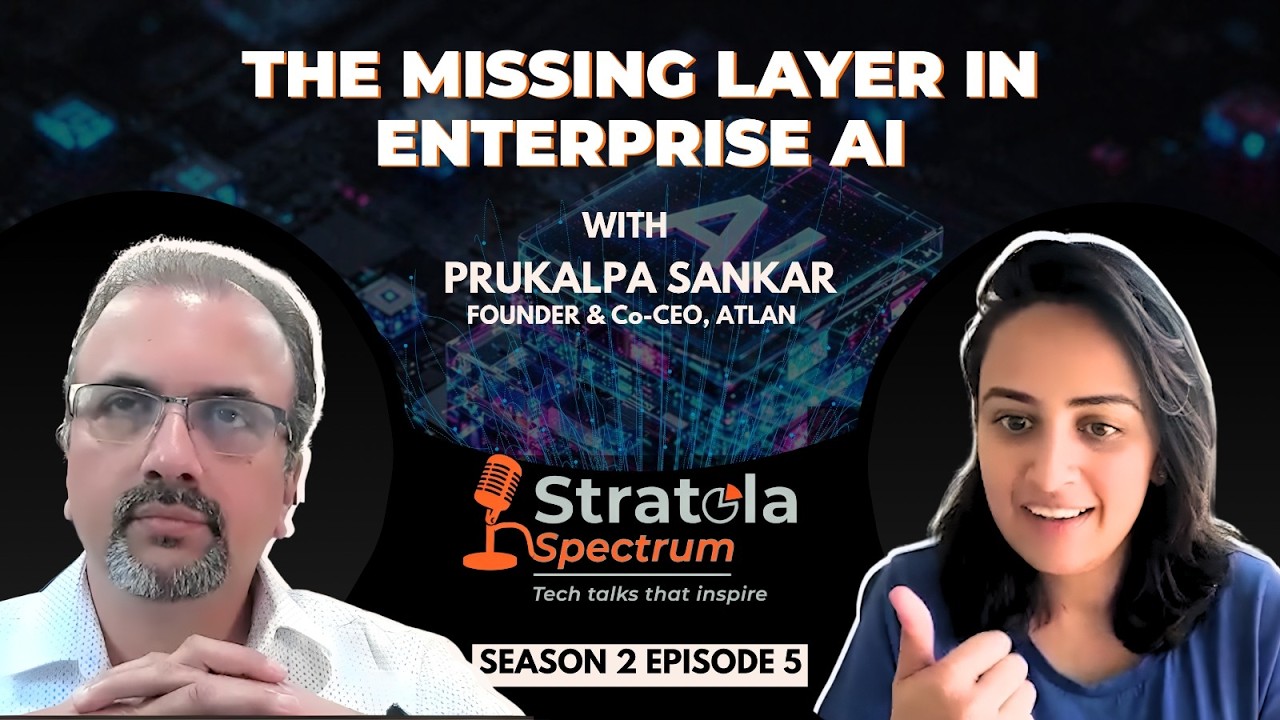

About This Episode
In Stratola Spectrum Episode 3, Dinesh Chandrasekhar, Chief Analyst, Stratola, speaks with Conor Twomey, a seasoned AI executive and founder of AI One, about what he heard and learned at Davos, and what it signals for AI code generation and autonomous agents.
Conor describes Davos as a rare intersection of geopolitics, technology, and business, with direct access to major AI leaders and executives. His core “spiky” Davos topic was self-writing software: agentic systems that can ideate, build, test, and deploy complete applications with minimal human intervention. He argues we are moving from AI assisting the software lifecycle (documentation, testing, autocomplete) toward increasingly autonomous software engineering, and he predicts that by 2029, AI will generate more software than all software produced since the beginning of computer science.
Dinesh challenges the practicality of this vision by sharing a real-world example: trying to build a Chrome extension using LLMs, where the model sometimes fixes the wrong problem and spirals into a debugging rabbit hole. Conor agrees this happens and points to emerging improvements that are making these systems more reliable: larger context windows, better memory, stronger code models, and rollback strategies instead of endlessly stacking patches.
From Davos, Conor highlights three major themes he took away:
- Separating AI engineering from AI science
- Semantic bleaching, where terms like “AI” and now “agentic” lose meaning due to overuse
- Non-linear change, where multiple frontier technologies combine to drive faster-than-expected shifts in business and competitive dynamics
He also describes three “messages” he brought to Davos, including the strategic impact of self-writing software, the idea that generative AI can interpret and triangulate data across systems without forcing a costly data lake migration, and the rise of “AI shoring”: desktop takeover style automation (like browser operators) that can execute workflows on behalf of users even when systems are not explicitly “agentified.”
Dinesh brings in the DeepSeek debate, emphasizing the importance of open competition but raising concerns about security, data sovereignty, and the possibility of hidden malicious behavior over time. Conor frames DeepSeek’s impact primarily as an economics shock that compresses the premium window for frontier models, expands the number of viable enterprise use cases, and accelerates adoption, while stressing that enterprises remain accountable for governance and testing.
The episode closes with a grounded definition of agents: autonomy and agency, shifting from complex rule trees to principle-based automation. Conor shares practical adoption examples, like pre-send marketing and compliance review agents, and explains how ai1 helps enterprises move from smarter systems to consolidation and finally to agentic workflows, without ripping out existing infrastructure.
Key Takeaways
Davos is a unique intersection of geopolitics, technology, and business, with unusually direct access to top AI leaders and executives. Conor’s main “spiky” topic there was self writing software and what it means for the future of enterprise tech.
AI is rapidly shifting from copilots to autonomous software generation, but reliability is still the main limiter today. Context windows, memory, better code models, and rollback mechanisms are compounding improvements, but production grade trust still needs strong testing and guardrails.
The “agent” label is getting semantically diluted, so the real value is better explained as principles based autonomy replacing brittle rule trees. A small set of well architected principles can replace hundreds of rules, improving maintainability, responsiveness, and coverage in regulated workflows.
DeepSeek changed the economics narrative by compressing the premium window for frontier models, which increases the number of viable AI use cases. Conor’s stance was: great for end users and adoption, but organizations must still own risk with continuous testing and governance regardless of model source.
AI One’s thesis is “automated interpretation” across siloed enterprise systems without forcing a costly data lake migration first. They focus on smarter decisions via data triangulation in place, then use telemetry to drive consolidation and eventually promote workflows into event driven agentic execution.